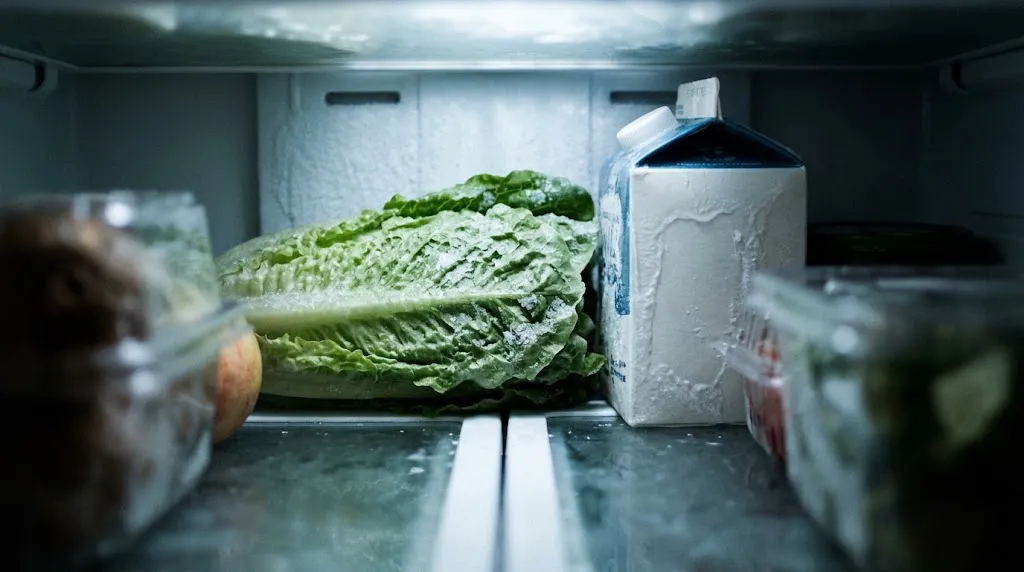
When food in the main refrigerator compartment turns icy, the cause is usually one of two things: a temperature setting that is too cold, or a part that lets too much freezer air into the fresh-food side, most often the air damper, a temperature sensor, or the evaporator fan. The first is a quick adjustment. The others are repairs. Here is how to tell them apart.
Key Takeaways
- FDA guidance is to keep the refrigerator at 40°F or below. Many people aim for the high 30s, and a setting that is too cold can freeze water-rich foods like lettuce, milk and eggs.
- Food freezing mostly at the back wall or near the vents points to airflow, such as blocked vents or a damper stuck open.
- A stuck damper, a failing temperature sensor (thermistor) or a faulty evaporator fan can all overcool the fresh-food compartment.
- Adjust the setting, wait about 24 hours, and check again with a thermometer before assuming a part has failed.
In This Article
Start With the Simple Fixes
❄Quick Checks Before You Call
Check the temperature setting. Compare it to your manual. If it was bumped colder or reset after cleaning, raise it slightly and wait about 24 hours.
Move food away from vents and the back wall. Cold air enters the fresh-food compartment through vents, and food right in front of them freezes first.
Do not overfill. Packed shelves block airflow and cause uneven cooling, with some spots too cold and others warm.
Measure instead of guessing. Put an appliance thermometer on a middle shelf and read it after several hours.
Think about the room. A very cold room, such as an unheated garage, can confuse a standard refrigerator's controls.
If the temperature reads correctly and food still freezes, one of the parts below is the likely cause.
Parts That Make a Refrigerator Too Cold
In most refrigerators, one evaporator in the freezer makes the cold, and a fan and a damper decide how much of it reaches the fresh-food side. A sensor tells the control board when to run the compressor and fan. When any of those fail, the fresh-food compartment can overcool.
| Part | What it does | What it looks like when it fails |
|---|---|---|
| Air damper | Controls how much freezer air enters the fresh-food side | Food freezing, especially near vents, while the freezer is normal |
| Thermistor (temperature sensor) | Tells the control board how cold the compartment is | Compressor and fan run too much, so the whole compartment is too cold |
| Evaporator fan | Moves cold air over the coils and into the compartments | Uneven cooling, frost buildup, noise |
| Control board | Directs the compressor, fan and damper | Erratic temperatures that do not respond to the settings |
Designs vary by brand and model. A technician can confirm which part is involved before anything is replaced.
When to Call a Technician
- Food keeps freezing after you adjust the setting and wait 24 hours.
- The thermometer reading is far from the setting.
- You see frost on the vents or the back panel.
- The fan is noisy or you hear it stop and start.
- The freezer is also running warm or cycling oddly.
Diagnosis matters because the same symptom can come from different parts, and guessing at parts adds cost. A technician can test the damper, sensor and fan before anything is replaced. See our refrigerator repair service. If your refrigerator is older, our repair-or-replace guide can help you weigh the cost.
Food still freezing after adjusting the settings?
Get a QuoteHow Complete Repair LLC Helps Black Diamond Homeowners
We diagnose refrigerators across Black Diamond and the greater Seattle Metro Area, test the suspect parts, and explain the cause and cost before any repair begins. Request a quote when you are ready.
Frequently Asked Questions
What temperature should my refrigerator be?
FDA and CDC guidance is 40°F or below for the refrigerator and 0°F or below for the freezer. Many people aim for the high 30s in the refrigerator. Your manual has the setting details for your model.
Why is only the food at the back of my refrigerator freezing?
The back wall and vents are usually the coldest spots, so food placed against them can freeze. Move items forward and away from the vents. If it keeps happening, a damper or airflow problem may be involved.
Is food that froze in the refrigerator still safe to eat?
Freezing alone does not make food unsafe, though texture and quality can suffer. Discard cracked eggs, and follow normal food-safety rules for anything that thawed and sat above 40°F.
Can a bad thermistor make a refrigerator freeze food?
Yes. If the sensor reports the wrong temperature to the control board, the compressor and fan can run too often and overcool the compartment.
Can I fix a stuck damper myself?
On some models it is reachable, but it means removing interior panels and working around electrical parts, so many homeowners prefer a technician. Always unplug the refrigerator before removing any panel.
Written and reviewed by Complete Repair LLC. Our certified technicians serve Black Diamond and the greater Seattle Metro Area, with transparent upfront pricing and documented estimates on every visit.
Refrigerator freezing your food?
Complete Repair LLC can find the cause and give you a clear estimate before any work begins. We serve Black Diamond and the greater Seattle Metro Area.
Get a Quote